
The lavender essential oil botanical family “Lamiaceae” is prolific in its production of aromatic and medicinal plants. One of its most famous members is lavender essential oil (Lavandula angustifolia), one of the most widely researched and commonly used essential oils in our modern pharmacopeia. It is so useful, in fact, that it is often called the “Swiss Army Knife of Essential Oils.” It would take a small book to describe all that is currently known about this precious oil, so this post will only hit some of the highlights for its helpfulness and use in everyday life.
Lavender Essential Oil Synergy
Lavender essential oil (Lavandula angustifolia) falls into a special category of essential oil chemistry.
In this group, oils demonstrate certain characteristics attributed to the beautiful synergy between monoterpenol constituents and ester constituents. In lavender, the primary constituents are linalool, a monoterpenol, and linalyl acetate, an ester. Other oils with this synergy are bergamot mint (Mentha citrata
WE RECOMMEND THE VIDEO: WHAT’S IN MY BAG| * CORONA VIRUS EDITION*
Published on 18 april, 2020. Hi everyone! ! ! I'm back with what's in my bag, corona virus edition. I thought it would be fun to film this for you guys, ...
), linaloe berry (
Bursera delpechiana), petitgrain (Bigarade) (
Citrus aurantium var. amara) , and neroli/petitgrain co-distill (
Citrus aurantium var. amara).
Lavender Essential Oil Safety Notes
Lavender is one of the safest essential oils, yet good safety practices are still necessary when using this powerful oil. So often when we think of something as being “relatively” safe, we forget the word “relatively,” and we also forget just how powerfully effective that oil can still be. Lavender essential oil should still be diluted appropriately for topical use. Linalool oxidizes easily, so lavender essential oil bottles should be kept closed, in a cool location, and away from direct light. Oxidized lavender has a greater risk of being sensitizing and irritating to the skin.
Lavandula angustifolia is one of the first essential oils that can be used with young children over the age of two years. Use it in very low dilutions, up to 1%, according to the child’s age. Lavender hydrolat is quite safe to use with all young children.
Although lavender is powerful, it does not replace emergency care in a serious situation. It may be helpful to use lavender in some cases while waiting for emergency care, but even then, do not use when the essential oil’s actions may mask important symptoms (i.e., in cases of head injury).
Lavender Essential Oil’s Calming Reputation
Lavender is well-known for its ability to calm and address anxiety. For “anxiety,” people often think of the clinical definition, causing some to think, “that does not apply to me, I do not suffer from anxiety.” Lavender helps in many different situations (e.g. nausea, pain, concentration issues, performance anxiety, breathlessness, stress, seizures, allergy attacks…), calming and soothing the mind, thereby often incidentally addressing the primary, obvious issue. In some cases using lavender may address both the emotional and physical issues. Try inhaling lavender aroma the next time you receive a vaccination or have a blood draw, both during and after the event (Kim, et al., 2011).
For all suggestions below, unless otherwise noted, lavender essential oil and any blends mentioned should be diluted appropriately for the situation before topical use. Inhalation is often faster-acting and more powerfully effective than topical use for many of the symptoms for which lavender is recommended.
Lavender Essential Oil First Aid Uses
DeRapper et al., 2013
See Buckle, 2015 regarding vaginal yeast infection
Other Uses For Lavender Essential Oil
Alzheimers and dementia: used as part of an overall aromatherapy treatment (Daiki et al., 2009).
Pregnancy: stress, anxiety, headaches, sleeplessness, hypertension, pre-eclampsia, cold and flu, sinus congestion, backache, constipation, labor pain relief, and postnatal wound healing and depression reduction (Tiran, 2012, Tiran, 2016).
Diaper rash: Lavender hydrolat can be used on a baby’s bottom to prevent or treat diaper rash (Catty, 2001).
Traditional Chinese Medicine
Used for cooling to hot conditions, such as inflammation, spasm, pain, and infection. Cools an overheated liver and stabilizes the heart (Mojay, 1997).
Emotional Use
- Inhalation is often the most effective way to support the emotions using essential oils.
- For calm composure: “An aromatic “Rescue Remedy, it works to calm any strong emotions that threaten to overwhelm the mind” (Mojay, 1997).
- Anxiety, worry: Excellent in combination with Citrus reticulata or Citrus bergamia.
- Confusion, frustration, anger, hysteria.
- Mood swings, emotional roller coaster.
- Stress.
- Psychological shock of injury (Worwood, 1991).
- Children: Use lavender hydrolat in bath water to help soothe an overwrought child. It can also be used as a linen spray, both at home and when traveling, to help a child feel more secure. Monster-B-Gone Spray is easy to make and can also be used for to help a child unwind at bedtime.
Here’s a recipe that is perfect to use when your child may be having emotional issues at bedtime.
Monster-B-Gone Spray
- Blend together in the spray bottle.
- Shake well.
- Shake well before each use. (Solubol or Disper can also be included to blend the oils better.)
- Make fresh every few weeks.
- Can be used to spray bed linens lightly before bedtime.
- Your child can use it to “spray monsters” if he or she awakens in the night and is frightened. One quick spray in the general direction of the closet or other monster hiding spot and the monsters are sure to stay away!
Cosmetic Use
Acne: use at 0.25% dilution (Zu et al., 2010) in aloe vera gel. Lavender hydrolat is also especially useful in the care of oily skin.
Hand cleanser: combine with aloe vera gel for a portable hand cleanser.
Deodorant: Include in handcrafted deodorants.
Lavender hydrolat is highly effective for use in skin care products, especially for fragile or sensitive skin. Be aware that it does not smell the same as lavender essential oil or lavender flowers. Spray on skin both before and after sun exposure to support healthy skin.
House Cleaning
Lavender essential oil has antiseptic and antifungal properties, making it an excellent choice in house cleaning sprays. The lavender hydrolat is also an effective choice, and may be preferred in homes with pets and young children.
Cooking
Both lavender essential oil and lavender hydrolat can be used in cooking and baking. One usually sees lavender extracts as ingredients in ice cream and baked goods, particularly shortbread, cookies, and cakes.
Different Types of Lavender
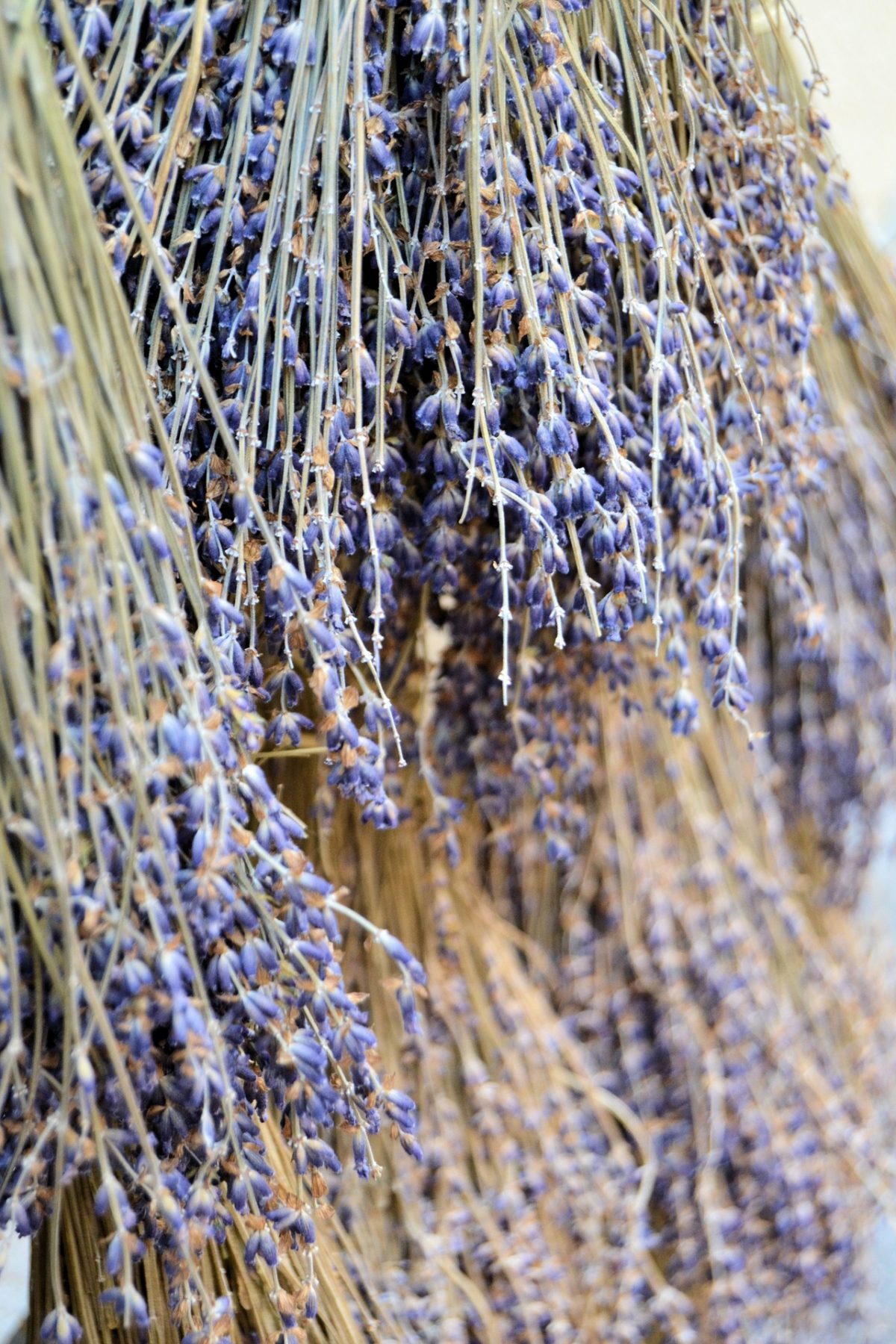
Although “a rose by any other name would smell as sweet,” the same is not the case with lavender. There are 39 species of Lavandula, several of which are distilled into essential oils, each having a distinct chemistry and therefore action in the human body. They are not interchangeable. Lavandula angustifolia is the lavender we usually want. It is also known as True lavender or English lavender and was formerly known by the botanical names L. officinalis and L. vera. This is the lavender that is famous for being grown primarily in southern France, although beautiful lavender essential oil also comes from Spain, Tasmania, Bulgaria, and the United Kingdom.
You may see names such as Lavandula stoechas, Lavandula x intermedia, Lavandula spica (or spicata), Lavandula latifolia, spike lavender, and lavandin, which have different chemistries and therefore different applications and safety concerns than true lavender. Lavender 40/42 is a standardized oil, which means that the balance of linalool and linalyl acetate are artificially balanced to have the ratio of 40%:42%.
A common misconception is that this oil is synthetic, but that is not necessarily the case. The chemicals used to standardize the ratios of constituents may have a natural provenance; it is only the overall chemistry that has been modified to make the oil smell and act the same from bottle to bottle. Standardization is very important in the fragrance industry and is also an important conversation, best left to another time, in the aromatherapy industry. Lavender is another excellent example of an essential oil where knowing the botanical name is of the utmost importance for safe and effective use.
REFERENCES
Altaei, D.T. (2012). Topical lavender oil for the treatment of recurrent aphthous ulceration. [Abstract]. American Journal of Dentistry, 25(1), 39-43. Retrieved on 08/27/2016 from http://www.ncbi.nlm.nih.gov/pubmed/22558691
Bakhtshirin F, Abedi S, YusefiZoj P, Razmjooee D. (2015). The effect of aromatherapy massage with lavender oil on severity of primary dysmenorrhea in Arsanjan students. Irananian Journal of Nursing and Midwifery Research, 20(1),156-60. Retrieved on 08/27/2016 from https://www.ncbi.nlm.nih.gov/pmc/articles/PMC4325408/
Cassella, S., J.P. Cassella, & I. Smith. (2002). Synergistic antifungal activity of tea tree (Melaleuca alternifolia) and lavender (Lavandula angustifolia) essential oils against dermatophyte infection. International Journal of Aromatherapy, 12(1), 2-15.
De Rapper, S., G. Kamatou, A. Vijoen, & S. Van Vuuren. (2013). The in vitro antimicrobial activity of Lavandula angustifolia essential oil in combination with other aroma-therapeutic oils. Evidence-Based Complementary and Alternative Medicine, 2013, doi:10.1155/2013/852049. Retrieved on 08/27/2016 from http://www.hindawi.com/journals/ecam/2013/852049/cta/
Daiki, J.,Y. Kimura, M. Tamiguchi, M. Inoue, & K. Urakami. (2009). Effect of aromatherapy on patients with Alzheimer’s disease [Abstract]. Psychogeriatrics, 9, 173–179. Retrieved on 08/27/2016 from http://www.ncbi.nlm.nih.gov/pubmed/20377818
Kim, S., H.J. Kim, J. L Yeo, S. J. Hong, J. M. Lee, Y. Jeon. (2011). The effect of lavender oil on stress, bispectral index values, and needle insertion pain in volunteers [Abstract]. Journal of Alternative Complementary Medicine, 17(9), 823-826. Retrieved on 08/27/2016 from http://www.ncbi.nlm.nih.gov/pubmed/21854199
Price, S. & P. P. Parr. (1996). Aromatherapy for babies and children. London, UK: Thorsons.